Technical Articles
Modern ESF Pin Terminology
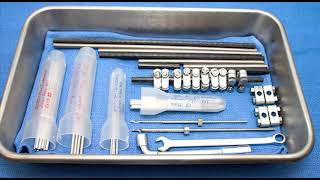
Many years of external fixation pin use centered around the Kirschner-Ehmer (KE) external fixation device and newer modifications of it. This has resulted in potentially confusing pin terminology that is poorly suited to the use of improved external fixation devices such as the IMEX™ SK™ external fixator. IMEX™ desires to develop and use proper fixation pin terminology which will clear up potential ordering errors and provide educators with a consistent vocabulary to train students, residents and practitioners. These changes will greatly simplify future pin discussion as well.
Continued Evolution of ESF Pins
The mainstay of external fixation in North America and much of the world for many years was the Kirschner-Ehmer (KE) device, and because of its historical dominance, fixation pin development and terminology was centered on pins for use with that clamp.
Proper Wire Tensioning with an IMEX™ Dyna™ Tensioner
Proper wire tensioning of small diameter wires on circular and hybrid fixator frames is simple when using the semi-calibrated IMEX™ Dynatensioner. Recommended tension levels vary according to ring diameter with 66mm rings at approximately 57kg, 84mm approximately 81kg, and 118mm rings at approximately 95 kg. The 50mm rings in the standard size system......
The First Major Improvement in ESF Pin Technology in Two Decades - 2010
IMEX™ DuraFace® half-pins (patents pending) demonstrate an average 55% increase in stiffness and a 3.7 fold increase in cyclic fatigue life compared to current positive-profile pins without an increase in cost. These mechanical improvements can prolong the integrity of the pin-bone interface in challenging orthopedic cases.
The SK™ ESF Advantage
Isolated connecting rod testing does not tell the entire story. Actual testing of ESF frame models confirms that frame simplification can be accomplished by incorporating strong connecting rods. Typical ESF frames were constructed of large SK™ components with medium pins as well as medium KE components with medium pins. By comparing frames with equivalent geometries and identical pins,.....
Review of SK™ ESF Mechanics
The most powerful way to simplify the ESF method lies in mechanical frame improvements that are not dependent on full-pins or complex frame geometries. In this respect, the SK™ ESF System is designed to be dramatically different from the KE and new KE-like systems that utilize traditional 1/8” and 3/16” connecting rods.
Review of SK™ ESF Clamp Design
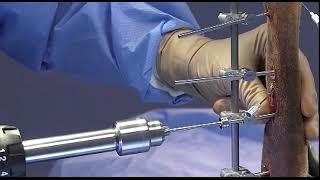
The user-friendly design of the SK™ single clamp allows for pre-drilling as well as placement of positive-thread pins through the pin-gripping clamp bolt. This eliminates the difficulty historically associated with the use of positive profile threaded pins.
Continued Evolution of ESF Concepts - 2003
Since the 1980’s, external skeletal fixation has become an increasingly popular method of veterinary fracture repair. Over that same time period one can follow a steady progression away from simple ESF frames toward more complex ESF frames - often utilizing multiple external rods and full-pins. For those of us who’s early external fixation experience was based on simple frames with smooth pins, the evolution to complex frames with threaded pins was a blessing. No longer would so many of our patients suffer from poor limb use and premature pin loosening
Escape Strategies When Using Simple External Skeletal Fixators - 2004
This issue will review the design philosophy of the SK™ ESF System and the economic and biologic advantages of simple, half-pin based frames. More importantly, this issue will introduce the concept of taking advantage of the fact that certain fixation pin sizes can be effectively gripped by two different SK™ clamp sizes as a handy method of staged disassembly when one begins with a simple ESF frame.
Stabilization of Coxofemoral Luxation Using the Toggle Pin Method
A number of surgical methods for maintenance of reduction of coxofemoral luxations are currently popular and include: the toggle pin method, ilio-femoral sutures to limit external rotation of the hip, and caudo-distal transposition of the greater trochanter. Each of these methods depends on the joint capsule and associated muscles for acute and especially, for long-term maintenance of joint stability
Using a Mini or Small SK™ Fixator with the Linear Distraction/Compression Assembly
In recent years, IMEX™ has received a number of requests from veterinarians to develop a method and produce instrumentation to allow for true linear distraction and compression for application in distraction osteogenesis or acute fracture reduction. The most common request was for use with type II fixators for treatment of antebrachial growth deformities when significant bone lengthening was needed in addition to angular deformity correction.
Hybrid External Skeletal Fixation - 2006
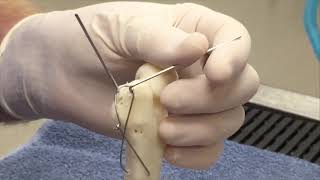
Hybrid external skeletal fixation (HESF) is rapidly becoming recognized as a very valuable tool for repair of fractures with a short distal or proximal segment. Short, juxta-articular fracture segments are often difficult to adequately purchase with a proper number of external fixation pins or bone screws, necessitating transarticular ESF frames or external coaptation of tenuous bone plate repairs. HESF offers a simple alternative for these repairs by using two to three small diameter wires for stabilization of small juxta-articular fracture segments while the primary bone segment is stabilized with traditional linear ESF components and pins.
Providing Clients with Affordable Alternatives in Today’s Economy - 2009
Many issues of the IMEX™ Update have focused on proper selection, application, and post-operative care of the external skeletal fixator. However, prior issues have paid little attention to the economics of external skeletal fixation. I have always felt that the external skeletal fixator is the most logical and economical device to enhance a practice’s orthopedic hardware armamentarium after IM pins and wires. This newsletter will compare start-up capital costs for the three major fracture repair devices: the SK™ ESF device, bone plates and screws, and interlocking nails.