Buy Banner

Tips-n-Tricks

IMEX $250 Shopping Spree


IMEX™ has seen practices around the world incorporate our equipment into a variety of useful, non-traditional techniques. These "Tips-and-Tricks", also known as "Pearls", are very helpful and appreciated by veterinarians and technicians. Our goal is to make them readily available so that everyone may benefit from each experience.


To encourage practices or individuals to submit tips, we are awarding a $250 shopping spree for each submitted "Tip-and-Trick" we select and share on our website. Simple solutions to daily tasks, ideas to simplify a surgical procedure and new applications for components are always popular.


Accepted formats:
Video, still images, sketches or even plain text - Please include all necessary contact information when submitting your tip or trick. This will assist us when awarding the lucky winner a $250 shopping spree.


Good luck!


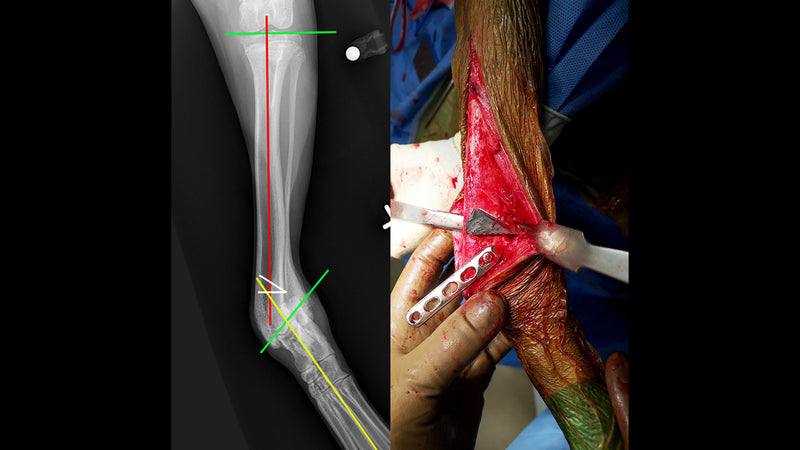
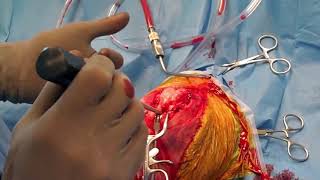
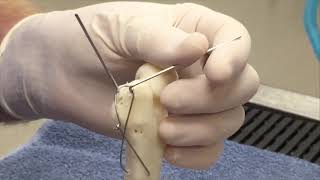
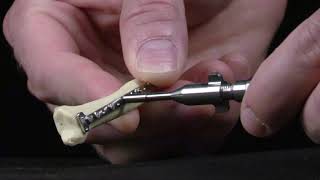
Accurately Reduce and Maintain TPLO Osteotomies

Winning tip submitted by Robert Sikes, DVM, Diplomate ACVS - Animal Surgical Group Mobile Practice, Arroyo Grande, CA

How do you accurately reduce and maintain reduction of a tibial plateau leveling osteotomy (TPLO) while testing for tibial thrust before plate application?

Robert Sikes, DVM, Diplomate ACVS, an early disciple and friend of TPLO inventor Dr. Barclay Slocum, shares his solution.

More Information


Reduce Contamination Following a Hanging Leg Prep

Winning tip submitted by Brent Herrin, DVM - Herrin Animal Hospital, Cassville, MO

Infection is a concern when performing any surgical procedure.  To keep infection from rearing its ugly head, surgeons consider a variety of methods to thwart these "bugs". They're always around, we're just working to keep them at bay.  

A method commonly performed with orthopedic surgery and one found in Dr. Brent Herrin's practice is the application of vet wrap and sterile drape material as a preventative measure; one that is easily prepared with a small amount of pre-planning.

More Information


Modifying an Angular Hinge for Transarticular ESF

A hinged external fixator is constructed by screwing hybrid rods with 6mm threads into each end of the angular hinge. Small or large SK™ hybrid rods can be used, but small are by far more commonly utilized. Hybrid rod length for each end of the fixator is chosen based on patient size and joint involved.....the angular hinge is not dynamic but slowly moved over a period of days. The modified hinge becomes very dynamic....
Watch the Video Video Icon

More Information


Eliminate Sharp Wire Ends

Breaking a fixation wire at the junction of a wire fixation bolt and CESF ringA common question asked in relation to circular or hybrid external fixation is, "After tensioning fixation wires, how do I handle the sharp ends?"

Two schools of thought exist; one group prefers to leave wires long and then pigtail or roll them to prevent sharp cut ends from being a hazard. The second group prefers to cut fixation wires as close as possible to their fixation point in order to eliminate the time and effort of curling excess wire below a ring.

More Information


Minimally Invasive Plate Osteosynthesis (MIPO)

Winning tip submitted by Dan Lewis, DVM, DACVS
University of Florida, Gainesville, FL

Minimally Invasive Plate Osteosynthesis A simple two-ring circular fixator construct is often used to distract fractures out to length and facilitate reduction when performing minimally invasive plate osteosynthesis. This is particularly useful when addressing antebrachial or crural fractures.

More Information


Hip Luxation DIY Drill Sleeve

Winning tip submitted by Mark Rochat, DVM, MS, DACVS
Oklahoma State University, Stillwater, OK

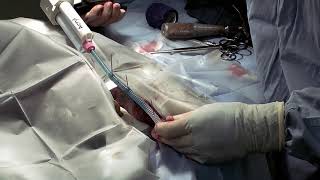
Hip Luxation DIY Drill Sleeve using a TB SyringeCraniodorsal hip luxation is a common problem in dogs. For various reasons, open reduction techniques are often employed to restore hip integrity and function.

While drill guides are commercially available, a less expensive option is to use a tuberculin syringe barrel for an impromptu, DIY drill sleeve.

More Information


Pin Caps | Protecting Patients, Owners and Staff

Pin caps applied to hybrid external skeletal fixation frameWinning tip submitted by Daniel D. Lewis, DVM, Diplomate ACVS
University of Florida, Gainesville, FL

Cut ends of fixation pins and IM pins have one thing in common - sharp ends that present a hazard to the surgeon, patient and owners. Daniel Lewis, DVM, DACVS at the University of Florida eliminates this danger with a quick-fix post surgery.

More Information


How to Easily Manage ESF Inventory

Easily Manage ESF InventoryWinning tip submitted by Zack Ricker, DVM
Oklahoma Veterinary Specialists

Time and money are hard to come by these days with all the have-tos, need-tos and got-tos. To help eliminate some of those incessant worries, Dr. Zack Ricker's tip simplifies orginization of your ESF equipment where it's always correctly inventoried, ready to use and ready to reorder.

More Information


Simplified Countersinking of an IM Pin

Tip submitted by Toby Eshelman, DVM
Veterinary Specialty Center

simplified countersinking of an intramedullary pin aided with a positive-profile esf pin and drill sleeveCountersinking of intramedullary pins is occasionally required in femoral, tibial, and humeral fractures to minimize morbidity due to joint interference or soft tissue impingement, most notably sciatic nerve irritation dorsal to the trochanteric notch. This procedure is traditionally done with a mallet and a pointed countersink, similar to a carpenter’s tool, which is placed against the end of the intramedullary pin. Difficulty visualizing the pin end in soft tissues and oblique or irregular (cut) ends of the intramedullary pin can make this a frustrating exercise. Small-diameter pins may be inadvertently bent if struck slightly off-axis, and confirmation of satisfactory depth can be difficult, particularly in the trochanteric fossa of the femur.

More Information


Surgery-friendly Draping Method

Tip submitted by Jeff Johnson, DVM
Blue Sky Animal Hospital P.A.

surgery-friendly draping methodManipulation of limbs during orthopedic procedures relies on drapes being free to move. Unfortunately, drapes often do not realign when limb manipulation is complete. Attaching self-retaining weights...

More Information


Unicondylar Fx Repair Utilizing Miniature Stick-pins

Tip submitted by Bert Shelley, DVM
Bradford Park Animal Hospital

Left QuoteUnicondylar Fracture Repair with Miniature Stick-pins Unicondylar fractures of the distal humerus are fairly common in small animal orthopedics. Fractures of the lateral aspect of the condyle are more commonly seen than medial fractures. The radius is the main weight bearing bone of the antebrachium and the radial head articulates with the lateral aspect of the conyle. Excessive force can then cause a shear injury of the lateral aspect of the distal humeral condyle.

More Information


Pin Tract Release Incision Using Mini Gelpi Retractors

Large Release Incision Using Mini Gelpi RetractorsIn the early days of using smooth pins with external skeletal fixation, minimal, if any soft tissue release was recommended. Since threaded fixation pins have become the standard, most authors and teachers recommend utilizing a drill sleeve to prevent tissue trauma. Unfortunately, the drill sleeve has become a method to atraumatically create an undersized soft tissue tunnel.

More Information


Wire Tensioning with a 20mm Spacer

Wire Tensioning with a 20mm SpacerThe 20mm spacer designed for building CESF ring blocks finds a dual purpose and frequent use as a wire tensioner extension (one of the first winners to our "Tips-n-Tricks" contest).

More Information


A Simple Method for Packing SK™ ESF Components

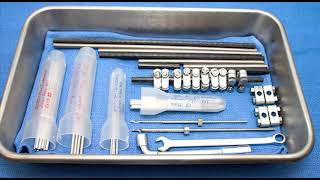
A Simple Method for Packing ESF EquipmentOne of the most common questions we recieve from veterinarians and technicians is, "How do I simplify packing of our ESF kits?" Various answers come to mind, some involving expensive trays and others requiring only a handful of supplies found in most veterinary practices.

The one we recommend is to use already available supplies.
Watch the Video Video Icon

More Information


Tibial Tuberosity Transposition without Tension Bands or K-wires

Tip submitted by Kevin Brumfield, DVM
Northwood Animal Hospital

Left Quote Patellar Luxation with Tibial Tuberosity Transposition Since 2001 (or so), I've been using the IMEX™ INTERFACE™ mini (toy breeds) or regular INTERFACE™ (medium to large dogs) pins, with positive-profile threads, in every surgical repair of medial patellar luxation with tibial tuberosity transposition (TTT). The historical standard for affixing the tibial tuberosity into position after the TTT is performed, involves the use of K-wires and a tension band. After experiencing a couple of cases where the K-wires loosened and then migrated, I tried the suggestion below.

More Information


Stifle Distraction using the SK™ Linear Distraction/Compression Device

Components used with a Canine Stifle DistractionThis tip demonstrates a previously un-described use for this device – that of a stifle distractor.   The figure shown demonstrates an opening of the medial stifle compartment after distraction has been applied to the stifle. Visualization of the medial compartment is enhanced by distraction.

More Information


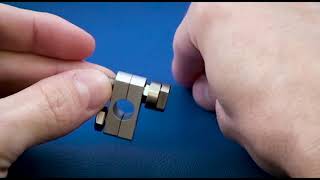
Proper Assembly of an SK™ External Skeletal Fixation Clamp

Tips-n-Tricks : Proper Assembly of an SK™ External Skeletal Fixation ClampDisassembling SK™ ESF clamps for cleaning purposes often results in improper reassembly when one is unfamiliar with the SK™ ESF clamp; leading to frustration on behalf of the surgeon. A quick and simple method for correct assembly of the SK™ external fixation clamp can eliminate this frustration while providing the surgeon or technician with an easy-to-remember technique.
Watch the Video Video Icon

More Information


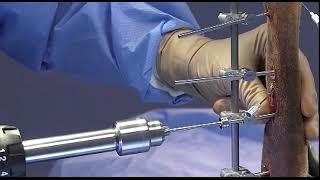
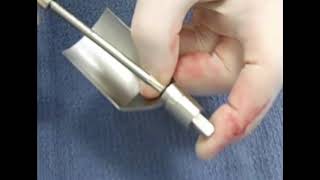
DIY AO-style Drill Sleeve

Pre-drilling of pilot holes has become a standard in external fixator pin placement. Pre-drilling is typically achieved through drill sleeves that fit securely into an SK™ ESF clamp. This method works well for pilot holes drilled after the initial proximal and distal pins are placed. But what about these first two pins?
Watch the Video Video Icon

More Information


Easily Separate ESF Pins in Your ESF Packs

Consider using a syringe case to segregate ESF pins within ESF packs. Keeping different diameter of...

More Information


callnow

Download Order Form »

Download Price List »

Download Catalog »

New Products

Find IMEX® Veterinary's latest exciting products here!
Learn more »

Email Us! imexdesk@imexvet.com